Asbestos Roof Replacement Adelaide Eastern Suburbs
Asbestos roof replacement in Adelaide runs $16,000 to $52,000 depending on roof size, covering licensed asbestos roof removal, air monitoring, disposal and a new Colorbond or tile roof. In South Australia a licensed removalist and an independent asbestos assessor are both legally required - we handle the whole sequence under one contract.
Get a Free Asbestos Roof Quote
We respond to most enquiries the same business day.
Licensed removal is the law in South Australia, not a preference
Asbestos roof sheeting must be removed under a SafeWork SA asbestos removal licence, with air monitoring carried out by an independent licensed asbestos assessor. That requirement is set by the Work Health and Safety Regulations 2012 (SA), not by any contractor's policy. You get one contract, one written quote and one point of accountability across the whole sequence - assessment, licensed removal, disposal documentation, and the new roof that goes back on. Asbestos roof removal and replacement runs as one continuous job here, not two separate trades you are left to coordinate yourself.
Why an Asbestos Roof Job in Adelaide's Eastern Suburbs Is Different
In the eastern suburbs, the asbestos usually is not on the house. That single fact changes the whole job, and it is the reason most pages about asbestos roofing Adelaide wide do not describe what you are actually looking at.
The main-house roof stock through this catchment is not asbestos cement. Character homes across Burnside and College Park carry original terracotta. Mid-century concrete tile dominates through Norwood and St Peters, much of it now reaching the end of a 40 to 50 year service life. Newer builds around Walkerville and Dulwich are typically Colorbond already. Asbestos cement sheeting was a cheap, fast roofing product, and it went onto the buildings nobody was trying to impress anyone with.
So in Burnside, Norwood, Toorak Gardens, Magill and the surrounding eastern suburbs, the asbestos roof we are called to is usually a detached garage, a carport, a garden shed, a lean-to addition off the back of the house, or a post-war infill property sitting between two older character homes. Occasionally it is a whole roof. More often it is 30 square metres over a double garage that has been quietly deteriorating behind a beautifully maintained bungalow.
That matters commercially, because the compliance work does not scale down with the area. On genuine commercial and industrial buildings the same regulatory overhead applies across a far larger roof, and commercial asbestos roof replacement is quoted alongside the new roof as one job - see commercial roof replacement for how that is priced. A licensed removalist still has to notify SafeWork SA five days ahead. An independent licensed assessor still has to run air monitoring. The waste still has to be wrapped, tracked and taken to a licensed facility. A 30 square metre garage roof carries most of the same fixed regulatory overhead as a 200 square metre house roof, which is why a small asbestos job is never proportionally cheap - and why any quote that treats it as a quick cash-in-hand strip-off is a quote from someone not doing it lawfully.
It also matters practically. An outbuilding asbestos roof sits at the back of a block, often hard up against a boundary fence, frequently with a neighbour's window three metres away. That geometry drives access, containment and the notification duties covered further down this page far more than the roof's size does.
Most asbestos roof removal Adelaide contractors quote the roof plane in front of them. We work across this catchment from a base in Kensington Park, and the Adelaide roof repairs work we do on the surrounding housing stock is what tells us where the asbestos actually is before we get on the roof.
How to Tell If Your Roof Is Asbestos
If the building went up before the mid-1980s and the roof is grey corrugated cement sheeting, treat it as asbestos until a test says otherwise. That is the position asbestos.sa.gov.au takes for homeowners, and it is the correct one - identification by eye is a prompt to test, never a substitute for testing.
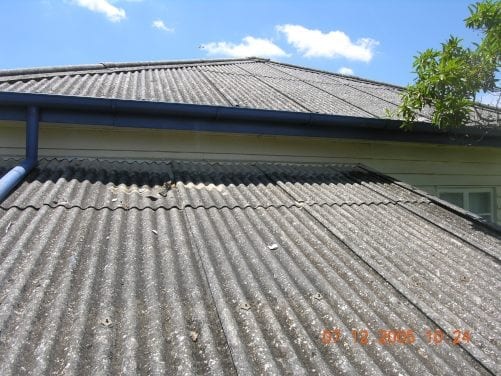
The product most people mean by an asbestos roof is corrugated asbestos cement sheeting. Australians almost universally call these asbestos roof sheets by the trade name they were sold under - Super Six. What distinguishes it from later fibre cement and from metal:
- Profile. Deep, widely spaced corrugations - a much bigger wave than corrugated steel, typically six corrugations across a sheet.
- Material feel. Cement, not metal. It does not dent, it does not rust, and it does not sound like steel when tapped. It cracks.
- Weight and rigidity. Noticeably heavy for its thickness and brittle rather than springy. Asbestos cement sheeting will not take your weight, which is why walking a suspect roof is genuinely dangerous.
- Colour and surface. Originally grey. Decades of weathering leave a chalky, powdery, often moss-streaked surface.
- Age. Asbestos was used in Australian building products until the 1990s, with a total national ban from the end of 2003. A roof installed after the mid-1980s is far less likely to contain it; a roof from the 1950s to the 1970s very likely does.
Super Six roofing means asbestos, in practice. Ask any Adelaide roofer about super six roofing asbestos content and the answer is the same - assume it is there until a test says otherwise. Super Six was the dominant corrugated asbestos cement roofing product in Australia for decades, and on any pre-1990 building the term is effectively a synonym for asbestos sheeting. A few specifics worth knowing:
- Super Six roofing profile. Six deep corrugations across the sheet width, with a much longer wavelength and greater depth than corrugated steel. That profile is the fastest visual identifier from ground level.
- Super Six roof sheeting sizes. Sold as Super Six corrugated roof sheeting in long single-span sheets, commonly used on garages, sheds, carports, verandahs and outbuildings across Adelaide.
- Super Six roofing weight. Far heavier than steel per square metre, because it is cement. That weight is why the framing underneath is often over-engineered for what replaces it, and why the structure gets inspected once the roof is off.
- Super Six roof cladding on walls. The same product was used vertically as wall cladding on sheds and lean-tos, so a roof job frequently extends to the walls beneath it.
- Super Six roof tiles. A common misnomer. Super Six was never a tile product - it is sheeting. If what you have is asbestos roof tiles rather than asbestos roof sheets, that is a different material and a different assessment.
Asbestos was also used in flat sheeting on eaves, gable ends and shed walls, so a roof replacement quote frequently uncovers more asbestos than the roof plane itself. That gets scoped at assessment rather than discovered mid-job.
One item worth ruling out: loose asbestos roof insulation in the roof cavity is a different and far more hazardous material. SA Government advice is that very few houses in South Australia contain loose asbestos insulation in the roof cavity - insulation here is usually fibreglass, rockwool, cellulose or foam. If you are unsure, that is a testing question for a licensed assessor, not a visual one.
Confirmation requires sampling and laboratory analysis. Do not sand, cut, drill or water blast a suspect sheet to get a look at it. Water blasting asbestos cement is specifically warned against by SA Government guidance, because it drives fibres into the air and across the surrounding property.
Who Can Legally Remove an Asbestos Roof in South Australia
| Who is doing the work | Non-friable, up to 10m2 | Non-friable, more than 10m2 | Friable asbestos |
|---|---|---|---|
| Homeowner, on their own home | No licence required by law | No licence required by law | Licensed removalist required |
| Builder, tradie or any contractor | Permitted without a licence | Class B or Class A licence required | Class A licence required |
| Air monitoring by independent licensed assessor | Not required | Required in SA for both Class A and Class B work | Required |
| SafeWork SA notification | Not required | Required, 5 days before work starts | Required, 5 days before work starts |
Source: asbestos.sa.gov.au and SafeWork SA. The 10 square metre threshold binds builders and tradies, not homeowners working on their own property - a distinction several Adelaide roofing pages get backwards.
The 10m2 Rule Is About Tradies, Not Homeowners
This is the most commonly misstated fact in Adelaide asbestos roofing content, and it is worth being precise about because it changes what your options actually are.
SA Government guidance for homeowners states it directly: "While there is no legal requirement for individual homeowners to have a licence to remove asbestos-containing material from their own property, some jobs are best left to the experts." There is no square metre cap on a homeowner working on their own home.
The 10 square metre threshold applies to work, not to houses. As the same guidance puts it, "Builders and tradies are not permitted to remove more than 10m2 of non-friable material without an asbestos removal licence." A residential asbestos roof almost always exceeds 10 square metres, so any contractor you engage needs a Class B or Class A licence.
There is a second consequence that almost nobody explains, and it works in your favour. The moment you engage a contractor, your home - or the part being worked on - legally becomes a workplace, and the Work Health and Safety Act 2012 (SA) applies to it. The legal duties to protect health and safety then sit with the licensed removalist and the contractor, not with you as the homeowner. You are not the one carrying the compliance risk once a licensed operator is on site.
Licence classes are defined by material, not by building type:
- Class B covers asbestos cement products - explicitly including fibro and corrugated roof sheeting - and any amount of non-friable asbestos.
- Class A covers everything, including friable asbestos and asbestos contaminated dust or debris.
Both are expensive to hold and audited. A Class B application fee is $4,691 for five years; Class A is $30,786 for five years. That cost base is the reason licensed asbestos removal is a specialist trade rather than something every roofer carries, and it is a useful sanity check when a quote comes in improbably low.
You do not have to take anyone's word for licensing. SafeWork SA publishes public registers of Class A licence holders, Class B licence holders, Class B holders with conditions, authorised asbestos removal supervisors, and licensed asbestos assessors. Anyone can look up any operator before signing anything - it is the fastest way to separate genuine asbestos roofing contractors from someone offering a cash-in-hand strip-off.
What South Australia Requires That the National Code Does Not
South Australia requires air monitoring on non-friable asbestos removal where the national Code of Practice says it is not needed. If you have been reading cost guides written for Brisbane, Sydney or Perth, this is the line item that will not appear in them, and it is on every compliant SA quote.
SafeWork SA publishes an explicit addendum correcting the national document. In its own words: page 26 of the How to Safely Remove Asbestos Code of Practice states that air monitoring is not required when removing more than 10 square metres of non-friable asbestos, and "This is not the case in South Australia." Air monitoring is required here for friable asbestos and for designated quantities of non-friable asbestos - which a roof exceeds.
The monitoring must be carried out by an independent licensed asbestos assessor, immediately before removal begins and continuously while the licensed removal work is carried out. Independent means not the removalist. On residential premises, the licensed removalist carrying out the work is responsible for arranging that monitoring, so it is not a separate errand that lands on you.
Alongside monitoring, a Class A or Class B licence holder working on a home in South Australia must:
- Notify SafeWork SA at least 5 days before the licensed removal work starts, through the SafeWork SA notification portal.
- Prepare an asbestos removal control plan before any work begins.
- Inform neighbours and nearby businesses in the immediate vicinity about the work.
- Ensure a supervisor oversees the removal.
- Provide workers with training, protective equipment and medical examinations.
- Use specified removal methods, waste containment and waste disposal procedures.
- Install signage and barricades, and provide decontamination facilities.
- Arrange a clearance inspection and clearance certificate on completion - by an independent competent person, or by a licensed asbestos assessor for Class A work.
The neighbour notification duty is not a formality in this part of Adelaide. In Dulwich, 28.5% of dwellings are semi-detached or attached against 14.6% across South Australia - and an asbestos garage or lean-to on a block like that sits directly on a shared boundary, sometimes with a neighbour's bedroom window inside the exclusion zone. On tight inner-eastern blocks the containment plan is shaped by the fence line, not by the roof area.
The five-day notification is also why an asbestos roof cannot be a same-day job, however small. If a contractor offers to start tomorrow, they are not notifying.
Two Regulators, and the Handover Happens at the Truck
Asbestos work in South Australia is split between two agencies, and knowing which one covers what makes a quote much easier to read.
SafeWork SA regulates the removal. Every licensed asbestos removal Adelaide operator works under its licensing, notification, air monitoring, control plan, supervision and clearance certificate - everything that happens while the material is still on your property.
The Environment Protection Authority regulates transport and disposal. As the EPA states, it is primarily responsible for the regulation of asbestos transport and disposal in South Australia, contactable on (08) 8204 2004. Once the sheeting is wrapped and loaded, responsibility for where it goes and how it gets there is an EPA matter. Asbestos roof disposal Adelaide wide is therefore a tracked, documented process rather than a trip to the tip, and asbestos removal Adelaide SA operators must be able to show where every load went.
A compliant job produces paperwork from both sides: a SafeWork SA notification and clearance certificate covering the removal, and waste tracking documentation covering the disposal. Keep both. If you sell the property, a buyer's conveyancer or building inspector asking what happened to the asbestos roof is a question best answered with documents rather than recollection.
Can You Legally Remove It Yourself, and Should You
Legally, on your own home, yes. On a roof specifically, it is the worst possible place to start.
As covered above, South Australian law does not require a homeowner to hold a licence to remove non-friable asbestos from their own property, and SA Government guidance sets out detailed safe work procedures for homeowners who choose to: a P1 or P2 respirator rather than an ordinary dust mask, type 5 category 3 disposable coveralls, 200 micron polythene sheeting, a 1:10 PVA to water mix for wetting down, non-powered hand tools, an H-class vacuum, never on a windy day, and neighbours informed before and after.
Roofs are the exception that swallows the rule, for three reasons the guidance itself flags:
The material will not hold you. SA Government advice on asbestos roofing is explicit that it is fragile, that you should lay planks rather than walk directly on the sheeting, and that fall protection and respiratory protection are both required to so much as inspect it. Weathered asbestos cement is brittle, and falls through roof sheeting are among the more common serious injuries in Australian construction.
Breaking it is the hazard. Intact, undisturbed, well-maintained asbestos cement presents no known health risk. Cracking a sheet while standing on it does the one thing the whole regulatory framework exists to prevent, in the least controlled way possible.
Disposal is not optional and not simple. Waste must be wrapped in 200 micron plastic, sealed airtight, and taken to a facility licensed to accept asbestos. Ordinary transfer stations and most council waste depots do not accept it.
There is a narrower version of DIY that is genuinely low risk and worth knowing: maintenance that does not release fibres. SA Government guidance notes that painting or sealing an asbestos cement surface without sanding, cutting or drilling only requires the usual precautions for those activities. That is not the same as restoring the roof, for the reason set out in the next section.
Asbestos Roof Repairs, Restoration and Painting - the Honest Answer
There is no such thing as a compliant asbestos roof restoration, and asbestos roof repairs are far more limited than most people expect. This is worth saying plainly, because a great deal of money gets spent on the wrong answer here.
Roof restoration works by cleaning the surface, repairing the substrate and coating it. Every one of those steps is a fibre-releasing activity on asbestos cement. SA Government guidance is direct: coating any weathered asbestos cement product is not recommended. Asbestos roof paint products marketed as encapsulation sealers do not change that - a sealed sheet is still a degrading sheet, and it is a more hazardous one to remove later because the coating has to come off with it.
Asbestos roof repairs are similarly constrained. Replacing a single cracked sheet means cutting, unfastening and handling asbestos cement, which is licensed removal work the moment the area exceeds 10 square metres. Drilling a new fixing through asbestos cement is prohibited fibre-releasing work regardless of area.
If you are searching for asbestos roof repair near me after a storm, what you almost certainly need is a licensed assessment followed by replacement of the damaged section or the roof - not a patch. And if you are searching for asbestos roof replacement near me, the practical filter is not proximity but whether the operator appears on the SafeWork SA register.
Repair, Restore or Replace an Asbestos Roof
| What you are seeing | The right call | Why, specifically |
|---|---|---|
| Intact sheeting, no cracks, still waterproof | Leave it and monitor | Undisturbed non-friable asbestos in good condition presents no known health risk. Removal is not urgent. Inspect after severe storms and hail. |
| Chalky, powdery, heavily weathered surface | Replace - see roof replacement | Weathering breaks down the cement matrix binding the fibres. SA Government guidance: roofing that has weathered, is structurally unsound or is no longer waterproof should be replaced. |
| Tempted to coat or seal a weathered roof | Do not - replace instead | SA Government guidance states directly that coating any weathered asbestos cement product is not recommended. Coating traps a degrading sheet under paint and makes the eventual removal more hazardous, not less. |
| Cracked or storm-damaged sheet | Licensed removal, not patching | A cracked sheet is already releasing fibres. Cutting and fixing a replacement sheet in becomes licensed removal work once the area exceeds 10 square metres, and drilling asbestos cement is exactly the fibre-releasing activity the rules prohibit. |
| Moss, lichen and general grime | Never pressure wash | Water blasting asbestos cement is specifically warned against. High-pressure water spreads fibres across the roof, the gutters, the garden and the neighbouring property. |
| Debris building up in the gutters | Handle wet - see gutter repairs and replacement | SA Government advice: where there is asbestos roofing, fibres may have collected in the gutter after rain. Wet the debris before handling it rather than scooping it dry. |
| Roof is sound but you want it to look better | Not a candidate for roof restoration or roof painting | Restoration and painting are the right answer on terracotta, concrete tile and Colorbond. On asbestos cement they are the wrong tool: the surface preparation those services depend on is prohibited fibre-releasing work. |
Asbestos cement is the one roofing material on which restoration and painting are not options. Where the roof has failed, replacement is the only compliant path.
Asbestos Roof Replacement Adelaide Cost and Price Bands
| Scope of work | Licensed removal and disposal | New roof | Combined |
|---|---|---|---|
| Garage, carport, shed or lean-to | Quoted individually | Quoted individually | Fixed compliance overhead dominates - see below |
| Whole house, 200-250m2, single storey, under 25 degree pitch | $8,000 - $14,000 | $25,000 - $30,000 + GST | Roughly $33,000 - $44,000 |
| Larger roof or two storey | $8,000 - $14,000 | $30,000 - $40,000 + GST | Roughly $38,000 - $54,000 |
| Scaffolding or difficult site access | Assessed with roof access | Approximately $10,000 + GST | Added to the above |
New roof pricing is ours and published across our roof replacement service. Licensed removal ranges are drawn from published Adelaide market figures for 200-300 square metre roofs and confirmed against your roof at assessment. Every quote is written and fixed before work starts.
Why a Small Asbestos Roof Is Not Proportionally Cheap
Asbestos roof replacement Adelaide cost questions almost always arrive in one of two forms - either asbestos roof replacement Adelaide prices for a whole house, or how much does it cost to get rid of asbestos on a single outbuilding. The two behave completely differently, and the table above is why. Asbestos roof replacement cost is really two costs stacked - a licensed removal cost with a fixed regulatory floor, and a re roofing cost that scales with area.
A common and reasonable expectation is that a 30 square metre garage roof should cost roughly a seventh of a 200 square metre house roof. It does not, and the reason is worth understanding before you compare quotes.
The compliance sequence is fixed regardless of area. A licensed removalist notifies SafeWork SA five days ahead whether the job is 30 square metres or 300. An independent licensed asbestos assessor attends and runs air monitoring either way. A control plan is written either way. Signage, barricades and decontamination facilities go up either way. A clearance inspection and certificate are issued either way. Waste is wrapped in 200 micron plastic, tracked and taken to a licensed facility either way.
What scales with area is the sheeting, the labour hours and the disposal tonnage. What does not scale is the regulatory floor underneath the job - and on a small outbuilding that floor is most of the price.
This is also the single most useful thing to know when a quote comes in far below the others. A price that low has usually removed the compliance sequence rather than the asbestos, which leaves the fibres, the liability and the undocumented waste with the property owner.
Disposal distance is one cost driver that runs in this catchment's favour. Adelaide has few facilities licensed to accept asbestos containing material, and the central one is Metro Waste at 19-25 Murray Street, Thebarton. From Burnside, Norwood, Toorak Gardens and the surrounding eastern suburbs that is a short metropolitan run rather than a cross-city haul, so disposal transport sits at the low end of what it costs elsewhere in Adelaide.
What Goes Back On After the Asbestos Comes Off
Once the roof is stripped and cleared, the replacement is a straightforward re roof, and the material choice is the same one any homeowner faces.
Colorbond steel is what most asbestos roofs are replaced with, and the decision to replace asbestos roof with Colorbond is the default for good reason. It weighs a fraction of what came off, installs quickly, and needs almost no ongoing maintenance. The important detail is thermal: steel only performs thermally with insulation underneath it, so we install insulated Colorbond and anticon blanket rather than sheeting straight onto battens. Skipping that step is the usual reason a new metal roof feels hotter than the old one. An asbestos roof replacement Colorbond conversion is the most common version of this job we do. Material options and profiles are covered in full on our Colorbond roof replacement page.
Tile is the alternative, and it is occasionally the required one. Where an asbestos roof sits on a property inside a heritage or character overlay area, the replacement material may need to match the surrounding streetscape rather than default to steel - which is a question to resolve before ordering, not after.
Because the structure underneath an asbestos roof was designed for asbestos cement sheeting, the framing is inspected once the roof is off and before anything new goes on. Battens, purlins and any timber that has been sitting under a leaking roof get assessed at that point. That inspection is part of the job, not a variation.
Development Approval Is Always in Play on an Asbestos Roof
On an ordinary re roof, the approval question depends on what you are doing. Like-for-like replacement - same material, same profile, same colour - generally does not require development approval. Changing roof material, altering the roofline or increasing roof height can trigger one.
Do you need planning permission to remove asbestos? Removal itself is a work health and safety matter rather than a planning one - but what you put back is a planning question, and that catches almost everybody out. An asbestos roof replacement is a material change by definition. There is no like-for-like option, because the original material has been banned in Australia since 2003. Every asbestos roof replacement is a change from asbestos cement to something else, which means the approval question is live on every one of these jobs rather than on some of them.
That likelihood rises sharply on properties inside a heritage or character overlay area, and much of Adelaide's eastern suburbs sits in exactly that category. Burnside and the inner east carry overlays that can require profile or material matching. We check your property against its council overlay as part of the quote, before anything is ordered, because discovering an approval requirement after materials have been manufactured to your roof is an expensive way to learn it.
Two protections worth knowing about, both of which apply to most jobs at this value:
Building indemnity insurance is required on domestic building work over $20,000 that needs council approval. Most full asbestos roof replacements clear that threshold on both counts.
Statutory warranties under the Building Work Contractors Act 1995 apply to domestic building work whether or not a builder raises them. The work must meet plans and specifications, be carried out with care using suitable materials, and be completed in a reasonable time. Claims can be made for up to five years after completion, with longer periods for breach of contract or negligence capped at ten years.
How an Asbestos Roof Replacement Runs
Step 1. Assessment and sampling
We inspect the roof and any associated sheeting on eaves, gables and walls. Suspected asbestos is sampled and confirmed by laboratory analysis before anything is scoped or priced. $0 call out.
Step 2. Council and overlay check
Because replacing asbestos is always a material change, we check the property against its council overlay before any material is ordered - particularly through Burnside and the inner eastern suburbs.
Step 3. One written, fixed quote
A single firm price covering licensed removal, air monitoring, disposal and documentation, and the new roof. Nothing is payable beyond the $100 refundable deposit until the job is complete.
Step 4. SafeWork SA notification
The licensed removal is notified to SafeWork SA at least 5 days before work starts, and an asbestos removal control plan is prepared. Neighbours in the immediate vicinity are informed.
Step 5. Containment and air monitoring
Signage, barricades and decontamination facilities go up. An independent licensed asbestos assessor begins air monitoring immediately before removal starts and continues throughout.
Step 6. Licensed removal and tracked disposal
Sheeting is removed under licence, wrapped in 200 micron plastic and sealed, then transported to a facility licensed to accept asbestos containing material. Waste tracking documentation is retained.
Step 7. Clearance inspection and certificate
A clearance inspection is carried out and a clearance certificate issued before the new roof begins. You receive the certificate and the disposal documentation for your records.
Step 8. Structural check and new roof
Framing, battens and purlins are inspected with the roof off, then the new Colorbond or tile roof is installed to current Australian Standards with a final inspection and handover.
FAQs
Asbestos Roof Replacement Questions
How much does asbestos roof replacement cost in Adelaide?
A whole-house asbestos roof replacement in Adelaide runs roughly $33,000 to $44,000 for a 200-250m2 single storey roof, and $38,000 to $54,000 on larger or two-storey roofs. That asbestos roof removal and replacement cost combines licensed removal and disposal with a new Colorbond or tile roof. Garages, carports and sheds are quoted individually, because the fixed compliance sequence makes small jobs cost more per square metre than large ones.
Can I remove an asbestos roof myself in South Australia?
Legally, yes - South Australian law does not require a homeowner to hold a licence to remove non-friable asbestos from their own home, at any area. Practically, a roof is the worst place to attempt it. Asbestos cement sheeting is brittle and will not take your weight, breaking it is the exact hazard the rules exist to prevent, and the waste must go to a licensed facility. Builders and tradies cannot remove more than 10 square metres without a Class B or Class A licence.
How do I know if my roof contains asbestos?
If the building predates the mid-1980s and the roof is grey corrugated cement sheeting with deep, widely spaced corrugations, treat it as asbestos until a test says otherwise. It will feel like cement rather than metal, it cracks rather than dents, and weathering leaves a chalky surface. Visual identification is a prompt to test, never a substitute - confirmation requires sampling and laboratory analysis.
Do I need council approval to replace an asbestos roof?
Often, yes. Replacing asbestos is a material change by definition, because the original material has been banned since 2003 and there is no like-for-like option. That makes development approval a live question on every asbestos roof job, and significantly more likely on properties inside a heritage or character overlay area - which covers much of Adelaide's eastern suburbs. We check the overlay before any material is ordered.
How long does an asbestos roof replacement take?
Licensed removal and clearance typically takes one to two days depending on roof size and access, followed by several days for the new roof. Add at least five days before any of that starts, because a licensed removalist must notify SafeWork SA five days before work begins. Any contractor offering to start tomorrow is not notifying, which means the work is not being done lawfully.
Is it safe to drink rainwater collected off an asbestos roof?
SA Health advises that provided rainwater tanks and asbestos roofing are well maintained, it is safe to drink rainwater collected off an asbestos roof. Asbestos has only been shown to cause health effects when fibres are inhaled. The maintenance qualifier matters: a badly weathered or damaged roof shedding material into the catchment is a different situation, and worth having assessed.
How much to remove asbestos garage roof, shed or carport?
Garage, carport and shed roofs are quoted individually rather than from a per square metre rate, because the compliance sequence does not scale down with area. Asbestos roof removal cost is set by that sequence, not by the roof. SafeWork SA notification, independent air monitoring, a control plan, containment, a clearance certificate and tracked disposal all apply to a 30 square metre garage exactly as they apply to a 300 square metre house. That fixed floor is most of the price on a small job.
Can an asbestos roof be restored or painted instead of replaced?
No. SA Government guidance states directly that coating any weathered asbestos cement product is not recommended, and the surface preparation that roof restoration and painting depend on is prohibited fibre-releasing work. Asbestos cement is the one roofing material where restoration is not an option. Where the roof has weathered, become structurally unsound or stopped being waterproof, replacement is the compliant path.
What paperwork should I receive after an asbestos roof removal?
Two sets, because two agencies regulate the work. SafeWork SA covers the removal, which produces the notification and a clearance certificate issued after a clearance inspection. The Environment Protection Authority regulates asbestos transport and disposal in South Australia, which produces waste tracking documentation. Keep both - a buyer's building inspector or conveyancer will eventually ask what happened to the roof.
Do my neighbours need to be told before the work starts?
Yes. A licensed asbestos removalist working in South Australia must provide appropriate information to neighbours and nearby businesses in the immediate vicinity before removal begins. On the tight blocks common through Dulwich, Norwood and the inner east, where a garage or lean-to sits hard against a boundary, that notification and the containment plan are shaped by the fence line rather than the roof area.
Is an asbestos roof dangerous if it is in good condition?
Undisturbed non-friable asbestos in good condition presents no known health risk, because the fibres are tightly bound in the cement and are not released unless the material is disturbed, damaged or badly weathered. An intact asbestos roof is not an emergency. It becomes a hazard when it deteriorates, cracks, or when someone works on it without controls - which is why inspection after severe storms and hail matters.
What We'd Actually Recommend
If the roof is intact and still waterproof, do not rush. Undisturbed asbestos cement in good condition is not a health risk and not an emergency. Plan the replacement around your own timeline and budget rather than around a scare. Inspect it after severe storms and hail, and act when it starts to deteriorate.
If it is weathered, chalky or leaking, replace it rather than treating it. Every remedial option - coating, sealing, pressure washing, patching - either releases fibres or traps a degrading sheet under a surface that makes the eventual removal harder. There is no maintenance path back from a failed asbestos roof.
If a quote is dramatically cheaper than the others, ask what it excludes. The best asbestos roof replacement Adelaide operators price the compliance sequence openly, because it is most of the difference between quotes. Then check the operator against the SafeWork SA public register of Class B licence holders. Asbestos removal Adelaide cost is driven by that sequence far more than by roof area: it has a fixed floor, and a price well under it usually means the sequence is not happening.
If the asbestos is on a garage or shed rather than the house, deal with it while other roofing work is on site. The fixed compliance overhead is the same either way, and combining the outbuilding with roof work on the main house is the one situation where the small job stops being disproportionately expensive.
Related Roofing Services
Roof Replacement
Full material options, pricing bands and the re roofing process once the asbestos has been removed and cleared.
Read more →Colorbond Roof Replacement
The most common replacement for asbestos cement sheeting, installed with insulation blanket rather than straight onto battens.
Read more →Gutter Repairs & Replacement
Guttering under an asbestos roof collects fibres after rain, and is normally replaced as part of the same job.
Read more →Commercial Roof Repairs
Asbestos cement sheeting is common on older commercial, industrial and warehouse roofs across Adelaide.
Read more →Book an Asbestos Roof Assessment
Free asbestos roof replacement Adelaide quotes, with no obligation, across Burnside, Norwood, Toorak Gardens, Magill and the eastern suburbs. Licensed removal, air monitoring, tracked disposal and the new roof, under one contract and one fixed written price.