
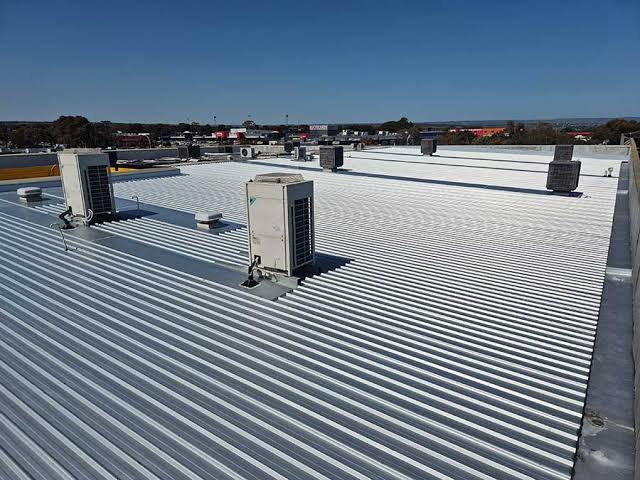
Commercial Roof Replacement Adelaide
Commercial roof replacement in Adelaide is priced per square metre, and current market rates run $64 to $175 to re-sheet in Colorbond or Zincalume. We replace roofs on warehouses, strata blocks, offices, retail and institutional buildings across the metro area, staged so the building keeps trading.
Get a Free Commercial Roof Assessment
We respond to most enquiries the same business day.
Nobody in Adelaide publishes what a commercial roof costs. We do.
Search commercial roof replacement cost and you will find residential guides, a handful of cost aggregators, and roofing companies who will tell you it depends. It does depend, but not so much that a number is impossible. Below are the current Adelaide market ranges by roof system and by building size, along with the six things that actually move the price. These are market ranges rather than a quote - your number comes from a site inspection, and it is free.
What a Commercial Roof Replacement Costs in Adelaide
Commercial roof replacement cost is set per square metre, not per job, and the system on the roof matters more than anything else. Published commercial roofing Adelaide rates for 2026 sit in these bands.
Re-sheeting in Colorbond or Zincalume: $64 to $175 per square metre. This is the dominant commercial roof in Adelaide and the one most replacements involve. The spread is wide because it covers everything from an accessible single-storey warehouse at low pitch through to a multi-level building needing crane lifts. Bulk rates drop from around $56 per square metre once you are over 1,000 square metres, which is why the average cost of commercial roof replacement falls as the roof gets bigger.
Low-pitch membrane systems: $72 to $145 per square metre. Commercial flat roof replacement cost sits slightly higher per metre than sheet steel because the substrate usually needs attention before anything goes over it. Genuinely flat roofs are rarer in Adelaide than the term suggests - most are low-pitch metal decks with box gutters.
Insulated sandwich panel: $110 to $225 per square metre. The premium system, used where thermal performance is part of the brief - cold storage, food production, some office fitouts. Commercial metal roof replacement cost lands here when the specification calls for insulation built into the panel rather than a separate blanket.
Box gutter replacement: $96 to $255 per metre. Almost never a standalone job. Box gutters are typically replaced as part of the re-sheet, because getting to them afterwards means lifting the sheets you just laid.
Asbestos removal, where present: $24 to $72 per square metre on top. Licensed work with independent air monitoring, priced separately and always as its own line.
Two things follow from those rates. First, the cost of commercial roof replacement is dominated by area, so a rough number is available to you the moment you know your roof area in square metres - and if you do not, your building plans or a rates notice usually will. Second, industrial roof replacement cost per square metre is generally lower than commercial, not higher, because industrial roofs are large, simple planes and the bulk rate applies across all of it.
Commercial Roof Replacement Cost by Building Size
| Building | Roof area | Typical total |
|---|---|---|
| Small commercial, shopfront or single tenancy | Under 300m² | $19,000 to $52,000 |
| Strata block, office or retail unit | 300 to 500m² | $32,000 to $87,000 |
| Warehouse or larger commercial building | 500 to 1,000m² | $36,000 to $112,000 |
| Medium commercial or industrial site | 1,000 to 3,000m² | $72,000 to $320,000 |
| Asbestos removal, where present | Priced per m² | $24 to $72 per m² additional |
| Fall-arrest or static line system | Per building | $2,800 to $20,000 installed |
What Actually Drives the Price
The range above is wide because six variables move it, and on any given building usually only two or three of them are in play. Commercial building roof replacement cost comes down to these six, in roughly their order of impact, and knowing which apply to you narrows a $64 to $175 spread to something much tighter.
Roof system. Sheet steel is the cheapest per square metre and the fastest to lay. Membrane costs more per metre and takes longer. Insulated panel is the most expensive and the most specified. This single factor accounts for most of the spread.
Area and access. Bigger roofs cost less per square metre, not more. What costs money is getting materials and people onto the roof - a single-storey warehouse with hardstand alongside is cheap access, a four-storey building on a narrow street needing a traffic permit and a crane booking is not. Access is often a larger line than most owners expect and we quote it separately so you can see it.
Fall-arrest and SafeWork SA compliance. Under the WHS Regulations 2012 (SA) any potential fall over two metres needs a documented control. A building with certified anchor points or a static line is cheaper to work on for every trade that ever goes up. A building without one carries the cost of an elevated work platform or scaffold for the duration.
Asbestos. Pre-1990 commercial roofs are frequently asbestos cement. It cannot be drilled, cut or pressure cleaned, removal is licensed, and South Australia requires air monitoring by an independent licensed assessor. It is a real cost and a real schedule item, and it is never a surprise if the roof is inspected properly first.
Occupied or trading sites. Working around a trading business means shorter working windows, sometimes night or weekend work, and staging the roof in sections so only part is ever open. It costs more per square metre than an empty building and almost always less than closing the doors.
Building height and crane requirements. Anything above two levels usually needs a crane lift for sheet bundles rather than a hoist, which brings booking windows, exclusion zones and often a permit into the job.
Everything on that list is visible at an inspection. A commercial roofing replacement quote that arrives without anyone having been on the roof is a guess, and the variance shows up later as a variation.
Repair, Restore or Replace
| Situation | What it usually means |
|---|---|
| Isolated leaks, sheeting otherwise sound | Repair. See commercial roof repairs |
| Fastener corrosion across one or two bays | Area refasten, not a full replacement |
| Corrosion at laps and cut edges across most of the roof | Replace. Patching a coated product that has failed at the coating buys months |
| Roof over 30 years old with recurring repairs | Replace. The repair spend has usually passed the replacement cost |
| Asbestos cement sheeting, any condition | Replace, and plan it. Repair options are extremely limited |
| Ponding water that has not drained after 48 hours | Investigate structure first. New sheets on a deflected frame will pond again |
| Building being sold, refinanced or re-leased | Replace. A roof at end of life is a valuation and due-diligence item |
Commercial Roof Replacement by Building Type
Commercial building roof replacement covers a much wider range of buildings than the word commercial suggests, and the buyer is different in each one. Who signs the contract changes how the job has to be quoted and staged.
Warehouses and distribution. The largest roofs and the simplest geometry. Long-run sheeting on portal frames, big box gutters, translucent light sheets that have almost always gone brittle before the steel has. Warehouse work overlaps heavily with our industrial roof repairs service, which covers factory roof replacement and industrial roof installation on production sites.
Strata blocks and apartment buildings. Strata roof replacement is a different process rather than a different trade. The decision runs through a committee, the money comes from a sinking fund or a special levy, and the quote often has to survive an AGM before anything happens. We write strata quotes to be read by people who are not in construction, with scope, exclusions and staging stated plainly, because that is the document that gets voted on. Body corporate roof replacement and apartment building roof replacement work the same way. Apartment roof replacement also means occupied units below every square metre of the work, so containment and noise windows matter more here than anywhere else.
Offices and institutional buildings. Smaller roofs, more penetrations, and plant decks with air conditioning units that have to be worked around or temporarily relocated. Church roof replacement sits here too and frequently involves heritage considerations, older roof forms and materials that are no longer manufactured.
Retail and strip centres. Multiple tenancies under one roof, which means multiple businesses whose trading hours all have to be respected, and usually a single owner or centre manager coordinating them. Staging is the whole job on these.
Older commercial stock generally. Building roof replacement on anything pre-1990 in Adelaide carries a real chance of asbestos cement, and pre-1960 stock frequently has roof forms and drainage that were never designed for the rainfall intensities now used in AS/NZS 3500.3. Both are cheaper to find at inspection than at demolition.
Roof Systems We Install
New commercial roof installation in Adelaide comes down to three systems plus the drainage and safety infrastructure that goes with them.
Long-run metal sheeting. Colorbond and Zincalume in Klip-Lok, Trimdek or Spandek profiles, laid to AS 1562.1 and fixed to AS/NZS 1170.2 wind loads. This is the default for commercial metal roof installation and it is what the large majority of Adelaide commercial roofs are. Concealed-fix profiles like Klip-Lok cost more and have no fastener penetrations through the pan, which is why they are specified at low pitch.
Low-pitch and membrane systems. Commercial flat roof installation in Adelaide usually means a low-pitch metal deck rather than a genuinely flat roof, with the waterproofing carried by the sheet and the box gutters rather than by a membrane. Where a true membrane is the right answer - plant decks, terraces, some retail podiums - it is priced separately and specified for the substrate underneath, not chosen from a catalogue.
Insulated sandwich panel. A steel-insulation-steel panel that delivers the roof and the thermal performance in one product. Standard for cold storage and food production, increasingly specified for offices where energy performance is part of the brief.
Box gutters and stormwater. Replaced as part of the re-sheet, sized to AS/NZS 3500.3, with overflow provision that discharges outside the building. This is the single most common thing we find undersized on older commercial roofs, usually because the building was extended without anyone recalculating the catchment.
Skylights and translucent sheeting. Commercial skylight replacement is done at the same time as the sheets, not afterwards. Fibreglass and polycarbonate have a much shorter service life than the steel around them, they go brittle and yellow, and a brittle light sheet is a fall risk as well as a leak. Industrial skylight replacement on sawtooth and monitor roofs follows the same logic.
Anchor points and static lines. If the building does not have a compliant fall-arrest system, the re-roof is the cheapest time it will ever be to install one, because the roof is already open and the crew is already there.
How a Commercial Roof Replacement Runs
Free site inspection and measure
We attend, get on the roof where it is safe, measure the area, assess the sheeting, drainage, purlins, penetrations and access, and identify asbestos if it is present. No call out fee, no inspection fee, no obligation.
Written scope and fixed price
Roof, drainage, access, safety systems and any asbestos removal quoted as separate visible lines with exclusions stated. Written to be read by a facility manager, a strata committee or a financial approver without translation.
Staging and approvals agreed
Working hours, trading windows, section sequence, crane or EWP positioning, permits and exclusion zones confirmed before day one. On strata jobs this is also when the quote goes to the committee.
Section by section replacement
The roof comes off and goes back on in sections. Only the section being worked is ever open, and nothing is opened that cannot be made watertight the same day.
Drainage, safety systems and handover
Box gutters, overflows and downpipes completed, fall-arrest certified where installed, site cleared, and you receive photographs of what was found and what was done along with product warranty documentation.
Replacing a Roof on a Building That Is Still Trading
Most commercial roofs get replaced over the top of a working business. That constraint shapes the job more than the roof does.
The roof is staged, never fully opened. We strip and re-sheet in sections sized so each one is watertight by the end of the day. On a large warehouse that means a re-roof measured in weeks rather than days, and it is the right trade - the alternative is a faster job with your stock under an open roof.
Working hours are yours to set. Night work, weekend work and shutdown windows are all normal on commercial jobs. Planned closedowns over Christmas and Easter are the ideal slot for a large replacement and they book out months ahead, so a decision in autumn is a very different conversation from a decision in November.
Containment goes in before anything comes off. Protection under the work area, not after the first leak. On apartment and retail work this is the difference between a disruptive job and a damaging one.
Noise, dust and access are planned, not managed on the day. Tenants, staff and customers get told what is happening and when. On strata jobs we provide the notice that goes out to residents.
Weather is a real schedule risk and we say so. An honest commercial reroofing service builds contingency into the programme rather than promising a date that assumes a dry fortnight in an Adelaide winter.
The Tax Side - What Your Accountant Will Ask
One of the most searched questions around commercial roof work has nothing to do with roofing. Owners want to know how the spend is treated, and the depreciation of a new roof on a commercial building is handled very differently from a repair.
We are roofers, not accountants, and none of this is tax advice. What follows is the shape of the question so you can have a faster conversation with the person who does advise you.
Repair versus capital is the whole question. In broad terms the Australian tax system treats work that restores something to its former condition differently from work that renews or improves it. A patch on a leaking box gutter and a full re-sheet of the same roof are not the same category of expense, even though both are roof work on the same building. Where the line falls on your particular job is a question for your accountant, and the answer depends on facts about the building and the work rather than on what the invoice is titled.
This is why the quote breakdown matters. A quote that lumps everything into one line gives your accountant nothing to work with. Ours separates the roof, the drainage, the access, the safety systems and any asbestos removal, because those components are not necessarily treated identically and your adviser may need to see them apart. Ask for that breakdown from anyone quoting you, not just from us.
Depreciation life of a new roof on commercial rental property is a question with a real answer, and it is not ours to give. Owners of income-producing commercial property should talk to their accountant or a quantity surveyor before the work starts rather than after, because the documentation that makes the claim straightforward is easiest to produce while the job is running.
Get the paperwork while the job is live. Photographs before and after, the itemised scope, product warranties and compliance documentation. It costs nothing during the job and is difficult to reconstruct a year later. We provide all of it as standard.
Where Adelaide's Commercial Re-Roofs Are
Commercial roof replacement work is not distributed the way residential work is. Our residential catchment is the eastern suburbs; commercial replacement is dispatched metro-wide from our base in Kensington Park, because commercial stock sits where the zoning is rather than where the housing is.
The northern logistics corridor - Wingfield, Dry Creek, Gepps Cross, Regency Park and out through Direk, Edinburgh, Burton and Waterloo Corner. This is the largest concentration of warehousing and distribution in the state, and it is where the biggest re-sheets are. Two things drive replacement here rather than repair. The sheds built through the 1980s and 1990s expansion are now thirty to forty years old, which is the end of a commercial roof's service life whether or not it is leaking yet. And as new facilities go up alongside them, owners of the older stock next door tend to bring their own roofs up to standard rather than be the tired building in a rebuilt precinct.
The defence and technical corridor - Osborne, Edinburgh and the surrounding supply-chain facilities. Purpose-built technical space with more roof penetrations, more plant, and tighter site access and security requirements than a standard warehouse. Staging and access matter more here than the roof area does.
Tonsley and the south - Tonsley, Edwardstown, Melrose Park and down through Lonsdale. Tonsley in particular is full of large-span roofs originally built for manufacturing and now carrying completely different uses. A roof designed for a factory and now sitting over offices, research space or retail has different drainage and thermal expectations than it was built with, and insulated panel is specified here more often than anywhere else.
Port Adelaide and the inner west - Port Adelaide, Rosewater, Ottoway, Thebarton, Mile End and Hindmarsh. Older stock, more asbestos cement, more sawtooth and monitor roofs, and a coastal environment that attacks cut edges and fixings far faster than inland sites. Replacement rather than repair is the usual answer here simply because of age.
The near-city fringe - Kent Town, Bowden, Norwood and the mixed-use corridors. Ground-floor commercial under residential above, which makes every roof job an occupied-building job with residents rather than staff underneath.
The eastern and inner suburbs - our home ground, and the strata blocks, professional offices, medical suites and retail strips through Norwood, Kensington, Burnside, Unley and Walkerville. Smaller roofs, more penetrations, heritage constraints on some, and a body corporate or committee rather than a single owner making the decision.
Two things about Adelaide's climate drive commercial replacement specifically. Long dry summers with sustained UV perish fastener washers, sealants and translucent sheeting well before the steel itself fails - so a roof can read as sound from the ground while every fixing on it has reached end of life, which is the point where refastening stops being economic against a re-sheet. Then winter frontal rain arrives in concentrated bursts onto box gutters sized decades ago, often for a smaller building than the one now standing. Coastal sites add salt, and salt finds cut edges first.
Choosing a Commercial Roof Replacement Contractor
A commercial re-roof is likely to be one of the larger single line items in a building's life, and the field is harder to compare than it looks. These are the questions that separate one quote from another.
Is the licence real and is it the right one? Roofing work over the contract value threshold in South Australia requires a licence under the Building Work Contractors Act 1995, and box gutters, downpipes and stormwater are licensed roof plumbing on top of that. Ask for both. Commercial roofing contractors in Adelaide who cannot produce a licence number are not a candidate.
Does the quote separate the roof from the access? Access, staging and safety systems are a large part of a commercial job and they are the easiest place to hide a variation. Seeing them as separate lines lets you compare like with like across quotes and tells you the contractor has actually assessed your building rather than applying a rate.
Have they been on the roof? A commercial roof replacement contractor quoting from an aerial photo has not seen the fastener condition, the lap corrosion, the purlin deflection or the asbestos. Those are the four things that change the number.
Who is doing the work, and are they insured for it? Public liability and workers compensation, current, and sighted before anyone climbs. On a commercial site the building owner carries real exposure if this is not right.
Will they work your trading hours? Most commercial roofing installers will say yes and mean weekdays. Ask specifically about nights, weekends and shutdown windows, and get it into the written programme.
Do they publish anything about price? Across every Adelaide commercial roof installation company we could find, not one publishes a rate or a band. That is not a coincidence and it is worth asking why. A commercial roof installation contractor confident in their pricing can tell you the range before the inspection and the number after it.
What happens if the weather turns? Ask what the programme assumes and who carries the cost of delay. The answer tells you how many of these they have actually run.
Looking for Commercial Roof Replacement Near You
Searching commercial roof replacement near me in Adelaide returns much the same list as a general roofing search, because most companies treat commercial as residential work with a bigger number attached. The commercial market here is genuinely small and the specialists are not always the ones ranking.
We work commercial across the whole Adelaide metropolitan area from a base in Kensington Park. That is deliberate and it differs from our residential work, which is concentrated in the eastern suburbs. A commercial building owner is not choosing a roofer by suburb - they are choosing one who has done their building type, can produce the licences, and will work around their tenants.
Local commercial roof replacement does have one genuine advantage worth naming: response time when something goes wrong mid-programme, and the ability to come back. A re-roof carries a workmanship position that lasts years, and a business that is actually here is a business you can still find.
Commercial roof installation near me and local commercial roof installation return the same field of results as the replacement searches, because they are the same job described with a different noun. Commercial flat roof replacement near me narrows it slightly, though in Adelaide most results will still be low-pitch metal work rather than true membrane.
If you have a commercial building anywhere in metropolitan Adelaide, the free inspection costs nothing, includes a measured roof area and a written band before any detailed quote, and puts you in a position to make the decision on numbers rather than on a sales conversation. You can also see the full range of roofing work we cover across residential and commercial.
FAQs
Common Questions About Commercial Roof Replacement in Adelaide
How much does a commercial roof replacement cost in Adelaide?
Current Adelaide market rates are $64 to $175 per square metre to re-sheet in Colorbond or Zincalume, $72 to $145 per square metre for low-pitch membrane, and $110 to $225 per square metre for insulated sandwich panel. A full warehouse re-roof of 500 to 1,000 square metres typically totals $36,000 to $112,000, and a medium commercial site of 1,000 to 3,000 square metres runs $72,000 to $320,000. These are market ranges rather than a quote - the inspection is free and the written price is fixed.
Why is the price range so wide?
Because six variables move it and only two or three usually apply to any one building - the roof system, the roof area and access, whether the building has a compliant fall-arrest system, whether asbestos is present, whether the site is trading during the work, and whether height requires a crane. All six are visible at an inspection, which is why a quote produced without one tends to become a variation later.
Should we repair or replace?
Repair while the sheeting is sound and the faults are isolated. Replace when corrosion has reached the laps and cut edges across most of the roof, when repair spend over a few years has approached replacement cost, or when the sheeting is asbestos cement. A roof over 30 years old with recurring leaks has usually already made the decision.
Does a bigger roof cost more per square metre?
No, less. Bulk rates start from around $56 per square metre over 1,000 square metres. Large simple planes are the cheapest commercial roofs to replace per metre, which is why industrial roof replacement cost per square metre is generally below commercial. What raises the rate is access difficulty, height and complexity, not size.
How do you handle a strata or body corporate roof replacement?
The work is the same and the process is different. Strata roof replacement decisions run through a committee and are funded from a sinking fund or a special levy, so the quote has to be readable by people who are not in construction and has to survive a vote. We write scope, exclusions and staging plainly, provide the resident notices, and stage the work around occupied units below.
Can you replace our roof while we keep trading?
Yes, and most commercial replacements are done exactly that way. The roof is stripped and re-sheeted in sections sized so each is watertight by the end of the day, with containment set up underneath before anything is opened. Night, weekend and planned shutdown work is all normal. Christmas and Easter closedowns are the ideal window for large jobs and book out months in advance.
How long does a commercial roof replacement take?
It depends on area, access and how much of the day we can work. A small commercial roof under 300 square metres with good access is measured in days. A warehouse re-roof of 500 to 1,000 square metres is measured in weeks because it is staged in sections. Trading-hours restrictions extend the programme and are agreed in writing before the start rather than negotiated during.
Our roof is asbestos cement. What changes?
Removal is licensed work, the sheeting cannot be drilled, cut or pressure cleaned, and South Australia requires air monitoring by an independent licensed assessor. It adds roughly $24 to $72 per square metre and it adds schedule. It is always quoted as its own line so you can see it. Repair options on asbestos cement are very limited, which is why these roofs are usually replaced rather than maintained.
What is the difference between commercial roof repair and replacement?
Scope and economics. Commercial roof repair and replacement are quoted from the same inspection but answer different questions - a repair addresses identified faults on a roof with service life left, a replacement resets the clock on a roof that has reached the end of it. We quote both where both are genuinely viable so you can see the numbers side by side rather than being told which one you need.
Do you install fall-arrest systems at the same time?
Yes, and a re-roof is the cheapest time it will ever happen. Under the WHS Regulations 2012 (SA) a potential fall over two metres requires a documented control, so a building without a compliant system pays for an elevated work platform or scaffold every time any trade goes on the roof. Installed during the re-roof, a static line or anchor point system typically runs $2,800 to $20,000 depending on the building.
How is the roof treated for tax?
That is a question for your accountant and we do not give tax advice. What we can say is that the Australian tax system broadly treats a repair differently from work that renews or improves, so a patch and a full re-sheet are not the same category of expense. Ask for an itemised quote that separates the roof, drainage, access, safety systems and asbestos removal, because your adviser may need to see those components apart. Collect photographs and documentation while the job runs rather than reconstructing them later.
Which parts of Adelaide do you cover for commercial work?
The whole metropolitan area from our base in Kensington Park. Commercial work is not restricted to the eastern suburbs the way our residential work is, because commercial buildings sit where the zoning is - the CBD and city fringe, the northern industrial belt, Port Adelaide and the inner west, and the southern corridor.
Related Roofing Services
Commercial Roof Repairs
Offices, retail, strata and mixed-use buildings. Box gutters, cladding and metal deck repairs with published price bands.
Read more →Industrial Roof Repairs
Warehouses, factories and distribution facilities. Long-run sheeting, sawtooth roofs and box gutters, staged around production.
Read more →Asbestos Roof Replacement
Licensed removal coordinated with the replacement roof under one contract, with independent air monitoring.
Read more →Colorbond Roof Replacement
Profiles, colours and insulation options, with what a Colorbond re-roof actually costs.
Read more →Get a free commercial roof assessment
Warehouses, strata blocks, offices, retail and institutional buildings across metropolitan Adelaide. Measured roof area and a written price band before any detailed quote. $0 call out, licensed under the Building Work Contractors Act 1995 and fully insured.