
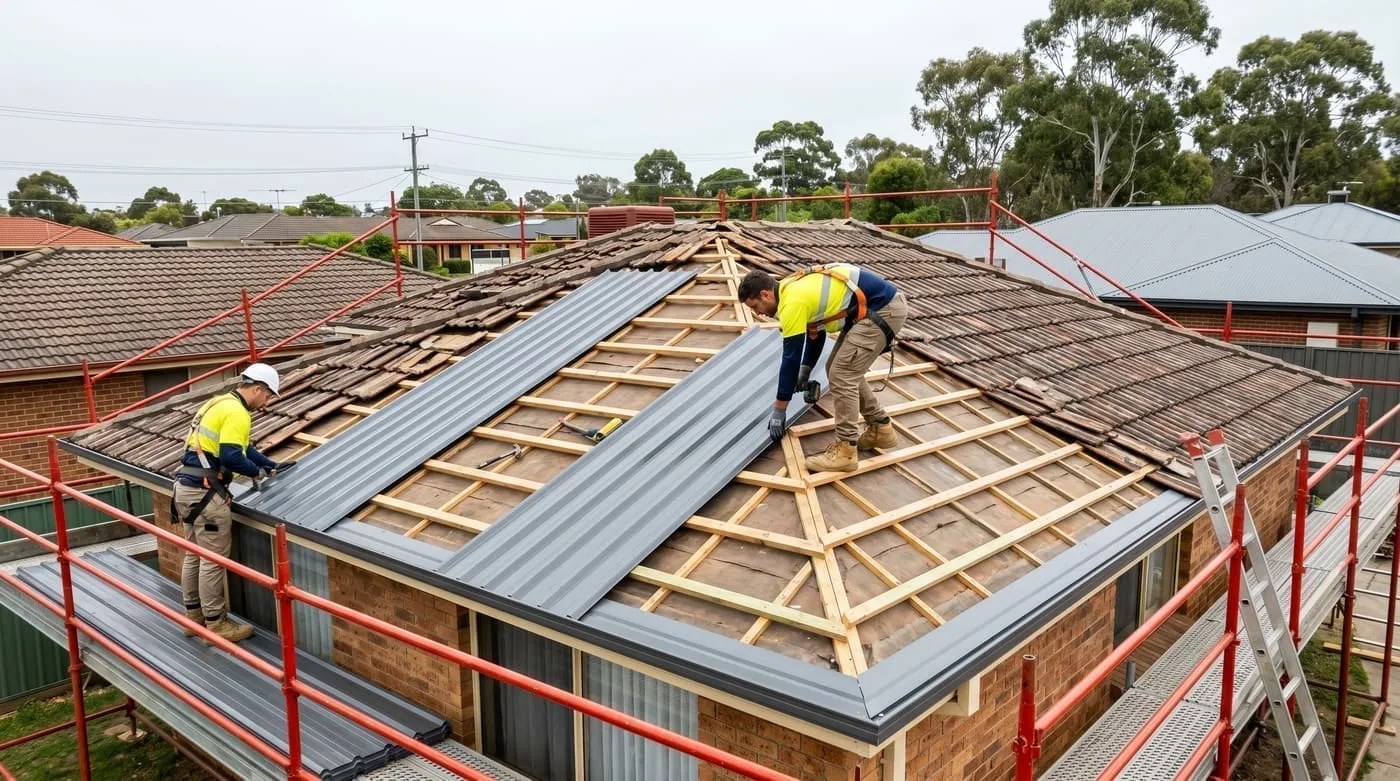
Roof Replacement Adelaide - Full Re Roofing Across the Eastern Suburbs
Roof replacement in Adelaide costs $25,000 to $30,000 + GST for most single-storey homes between 200m² and 250m² at under 25° pitch, rising to $30,000-$40,000 + GST on larger roofs. A standard re roof takes 5 to 10 working days from tile removal to final flashings.
Get a Free Roof Replacement Quote
We respond to most enquiries the same business day.
Roof Replacement and Re Roofing in Adelaide - Costs at a Glance
- Single-storey re roof, 200-250m², under 25° pitch - $25,000 to $30,000 + GST
- Larger roofs, same specification - $30,000 to $40,000 + GST
- Scaffolding or difficult site access - adds approximately $10,000 + GST
- Timeframe - 5 to 10 working days for a standard home
- Materials - Colorbond and Zincalume steel to AS 1562.1, tile to AS 2050
- Included on every re roof - new sarking, new battens, insulation blanket, all new flashings and cappings
- Solar panels - removal and refit coordinated with a licensed solar installer
- Old roof removal and disposal included - skip bin on site, no debris left behind
- Licensed under the Building Work Contractors Act 1995 since 2009, fully insured
Why Choose Us
Why Choose Us Among Adelaide Roof Replacement Contractors
Three decades re roofing across Adelaide's housing stock, from heritage terracotta to modern Colorbond.
Re roofing and replacement work completed across the Adelaide metro area.
Licensed under the Building Work Contractors Act 1995 since 2009, compliance documentation on request.
We recommend replacement only when restoration genuinely won't hold - not to sell a bigger job.
A firm, itemised price covering materials, scope and timeframe before anything is booked in.
All re roofing work is backed by a workmanship guarantee of up to 15 years, on top of the manufacturer's material warranty.
Do You Actually Need a Roof Replacement? How to Tell
| What you're seeing | Most likely the right call | Why |
|---|---|---|
| Widespread tile deterioration, repeated leaks appearing in different areas each rain event, roof at 25-30+ years | Full roof replacement | Past this point, restoration is money spent on a roof that needs replacing anyway. Replacement resets the whole system - sarking, battens, flashings included. |
| Structural sagging in the roofline, or battens and timbers showing rot when inspected from the roof space | Full roof replacement | Structural problems cannot be coated or repointed over. This is the one situation where replacement is not a judgement call. |
| Pointing cracked across most ridge lines, surface wear widespread, but tiles intact and structure sound | Roof restoration | Restoration costs a fraction of a re roof and buys years of service life. Replacing a structurally sound roof is money wasted. |
| A handful of cracked tiles, one failed flashing, a single leak point | Roof repairs | Isolated faults do not justify replacement. A targeted repair is a fraction of the cost. |
| Metal roof with rust at fastener points and in valleys, steel not yet perforated | Metal roof restoration | If the steel underneath is sound, recoating and resealing defers the cost of re-sheeting by years. |
| Fibro or asbestos-cement sheeting on a pre-1990 property | Asbestos roof replacement | Asbestos sheeting must be removed by licensed professionals before any new roof goes on. It is never a standard re roof. |
| Roof is sound but you want a different look, better insulation, or lower heat load | Colorbond roof replacement | A tile-to-Colorbond conversion is a legitimate discretionary re roof - lighter structural load, better thermal performance with an insulation blanket. |
Roof Replacement Cost Adelaide - Real Figures, Including the Cost of Reroofing a House
| Job | Typical cost | What drives the price |
|---|---|---|
| Single-storey re roof, 200-250m², pitch under 25° | $25,000 - $30,000 + GST | The most common Adelaide re roof. Straightforward access, standard pitch, no structural work. |
| Larger roof, same specification | $30,000 - $40,000 + GST | Roof area is the single biggest cost driver. Above roughly 250m², price scales with square metres. |
| Scaffolding or difficult site access | Add ~$10,000 + GST | Two-storey, steep pitch above 25°, or sites where a truck and skip cannot get close to the roofline. |
| Tile-to-Colorbond conversion | Within the ranges above | Removing tile and installing steel is not inherently dearer - Colorbond installs faster than tile and needs less structural support. |
| Solar panel removal and refit | Quoted separately | Panels must be removed before re roofing and refitted after, by a licensed solar installer - it is electrical work, not roofing. |
| Structural repair found during removal | Quoted on discovery | Rotted battens or damaged rafters are only visible once the old roof is off. We quote before proceeding, never after. |
| Asbestos sheeting removal | Quoted separately | Licensed removal and compliant disposal. See asbestos roof replacement. |
| Roof restoration (for comparison) | $3,500 - $7,000 | See roof restoration - the right call when the roof is structurally sound. |
These are indicative market ranges for roof replacement Adelaide homeowners can expect, not a quote. Roof area, pitch, access, material choice and what we find under the old roof all move the number. We measure on site and give you a firm written price before anything is booked in - free, and with no obligation to proceed.
Colorbond vs Tile Re Roofing - Which to Choose
| Factor | Colorbond / Zincalume steel | Concrete or terracotta tile |
|---|---|---|
| Structural load | Light - roughly a tenth the weight of tile, often allowing re roofing without structural upgrade | Heavy - requires the existing structure to be rated for it |
| Installation time | Faster - large sheets cover area quickly | Slower - laid tile by tile |
| Thermal performance | Strong with an insulation blanket installed underneath; poor without one | Good inherent thermal mass, slower to heat and cool |
| Adelaide UV and hail | Resists hail cracking; hail can dent sheeting cosmetically | Terracotta and concrete both crack under hail impact |
| Maintenance | Minimal - periodic fastener and flashing checks | Ongoing repointing and rebedding of ridge capping |
| Heritage and character areas | May not be permitted where the original profile must be retained | Terracotta matching is often required in character overlay areas |
| Standard installed to | AS 1562.1 metal roof cladding | AS 2050 tile roofing |
Re Roofing Adelaide - The Roof Types We Replace
Roof replacement Adelaide wide covers five distinct roof types, and each fails differently and on a different timeline.
Concrete tile roof replacement. The most common roof on Adelaide homes built from the 1960s onward. Concrete tiles lose their surface coating over decades, become porous, and start absorbing water rather than shedding it — at which point the added weight and freeze-thaw cycling accelerate cracking. Once deterioration is across the whole roof rather than isolated, replacement is the economic call.
Terracotta tile roof replacement. Common on character homes through Toorak Gardens and the older eastern suburbs. Genuine terracotta is durable — often outlasting the pointing and bedding holding it in place — so full replacement is less often necessary than with concrete. Where it is, matching the original profile matters both for appearance and, in character overlay areas, for approval. Discontinued profiles can usually be sourced through salvage.
Metal and Colorbond roof replacement. Older galvanised iron, Zincalume and early Colorbond roofs reach a point where corrosion has perforated the sheeting rather than sitting on the surface. Once perforated, re-sheeting is the only durable answer. New sheeting is installed to AS 1562.1, with correct fastener specification and flashing details.
Decramastic tin tile roof replacement. Pressed-metal tiles with a stone-chip coating, widely installed in Australia through the 1960s and 70s. The coating sheds over time, the underlying steel corrodes, and these roofs commonly reach end of life around the 40-50 year mark. Replacement almost always means converting to sheet Colorbond, since decramastic is no longer manufactured.
Asbestos-cement roof replacement. Fibro sheeting on pre-1990 properties, still found on original roof sections and outbuildings around Magill and the older northern-eastern suburbs. Removal is licensed work carried out before any new roof goes on — see asbestos roof replacement Adelaide for the licensed removal process and cost bands.
What a Complete Re Roof Actually Includes
A roof replacement quote that only covers the roof covering is not a replacement quote. A full re roof renews the entire system, and the components below are where cheaper quotes cut scope.
Sarking. The membrane layer that sits between the battens and the roof covering. It provides a secondary water barrier, controls condensation, and turns any minor water entry into a controlled drip that exits at the gutter instead of a ceiling stain. Many Adelaide roofs built before sarking became standard practice have none at all. Every re roof we carry out includes new sarking — it is not an upgrade item.
Battens. The horizontal timbers or 40mm metal sections the roof covering fixes to. Old timber battens frequently show rot or borer damage that is only visible once the covering comes off. New battens are installed as standard on a full replacement.
Insulation blanket. Installed under metal roofing, this is what makes a Colorbond roof thermally comparable to tile. A steel roof without an insulation blanket radiates heat straight into the roof space through an Adelaide summer. Skipping it is the single most common way a re roof quote gets made cheaper.
Ventilation and condensation control. An under-ventilated roof space traps warm moist air against the underside of the sheeting, where it condenses and drips back onto the ceiling — a problem often misdiagnosed as a leak because it appears in the absence of rain. Correct ridge and eave ventilation is specified as part of the replacement, not added later.
All new flashings, cappings and valley iron. Chimney and skylight flashings, wall junctions, ridge and hip cappings, and valley iron are all replaced. Reusing old flashings on a new roof is a false economy — they are the components most likely to fail first, and replacing them later means disturbing new roofing.
Removal and disposal. The old roof covering comes off and leaves site. A skip bin is placed on site for the duration and removed at completion. Tile disposal is included in the quoted price rather than billed as an extra.
Solar Panels and Re Roofing - What Happens to Your System
South Australia has among the highest rooftop solar penetration anywhere in the world. On a large share of the homes we re roof across the eastern suburbs, panels are already installed — and how that gets handled is one of the biggest practical differences between a re roofing quote that has been thought through and one that hasn't.
Panels have to come off. There is no way to replace a roof underneath a mounted solar array. The panels, rails and mounting feet all come off before the old covering is removed, and go back on once the new roof is finished and watertight.
It is electrical work, not roofing work. Disconnection, removal and reconnection is carried out by a licensed solar installer, not by roofers. We coordinate the timing into the re roofing schedule so panels come off the day before removal starts and go back on once flashings are complete — but the electrical work itself sits with the appropriate licensed trade.
It is quoted separately, and it should be. Panel count, mounting system, inverter arrangement and whether the array is being reinstalled as-is or upgraded all affect the cost. Any roof replacement quote that silently ignores an existing solar array has either missed it or is planning to raise it as a variation later.
Re roofing is the right time to reconsider the mounting. Panels being off the roof anyway is the cheapest opportunity you will ever get to correct a poorly positioned array, replace ageing mounting hardware, or install proper flashed penetrations rather than the sealant-dependent fixings used on many older installations. Sealant-only roof penetrations under a solar array are a common leak source we find during inspections.
What You're Actually Covered By - Warranties on a New Roof
A roof replacement is a five-figure purchase, and "we offer a warranty" is not a specification. There are three separate layers of cover on an Adelaide re roof, and they protect different things.
Manufacturer material warranty. Covers the roofing product itself — Colorbond and Zincalume steel carry a BlueScope warranty whose term varies by environment and distance from the coast. Adelaide's eastern suburbs sit inland, in a more favourable corrosion category than beachside areas, which generally means better warranty terms than a coastal property on identical product. This warranty covers the material, not the installation.
Workmanship guarantee — up to 15 years. Covers the installation itself, which the material warranty explicitly does not. Most roof failures in the first decade are installation failures rather than material failures: incorrect fastener specification, poorly formed flashings, inadequate falls. All our re roofing work carries a workmanship guarantee of up to 15 years, on top of the manufacturer's material warranty. Ask any competing quote to state its workmanship term in years — many won't, because there isn't one.
Statutory warranty under South Australian law. This is the layer almost nobody mentions, and it exists whether or not a builder brings it up. Under the Building Work Contractors Act 1995, domestic building work carries statutory warranties — the work must meet plans and specifications, be carried out with care using suitable materials, and be completed in a reasonable time. Claims can be made for up to five years after the work is finished, with longer periods for breach of contract or negligence capped at ten years. Building indemnity insurance is separately required on domestic work over $20,000 that needs council approval, which covers most full roof replacements.
Ask any roof replacement quote which of these three you're getting. A quote that only names the manufacturer's warranty is covering the steel, not the workmanship.
Our Roof Replacement Process
Step 1. On-Site Measure and Roof Space Inspection
We measure the roof, inspect the roof space, and assess battens and structural timbers. This is also where we confirm replacement is genuinely the right call rather than restoration.
Step 2. Written Quote and Scope of Works
A firm itemised price covering material, sarking, battens, insulation, flashings, removal and disposal - so you can compare it line by line against any other quote. Free and no obligation.
Step 3. Council and Overlay Check
Changing roof material, profile or height can require development approval, particularly in heritage or character overlay areas across Burnside and the inner east. We confirm this before work is scheduled, not after.
Step 4. Materials Ordered, Solar Coordinated
Sheeting or tile is manufactured to your measured roof. Where solar panels are installed, removal and refit is coordinated with a licensed solar installer as part of the schedule.
Step 5. Skip Bin Placed, Old Roof Removed
A skip goes on site and the old covering comes off in sections, so the roof is never left more open than the weather allows. Any structural issue found underneath is quoted before we proceed.
Step 6. Battens, Sarking and Insulation Installed
New battens fixed, sarking laid, insulation blanket installed under metal roofing. This is the stage that determines how the roof performs for the next 30 years.
Step 7. Roof Covering, Flashings and Cappings
New sheeting or tile installed to AS 1562.1 or AS 2050, followed by all new flashings, valley iron, ridge and hip cappings.
Step 8. Site Clean, Skip Removed, Final Handover
Site cleared, gutters flushed of debris from the works, skip removed, and a final walk-through against the agreed scope before we call it done.
Adelaide Conditions, Council Overlays and Why Local Detail Matters
Adelaide's climate sets the specification. Summers run hot and dry — January and February average above 29.5°C with only two to three rain days a month — which is why insulation and roof-space ventilation matter more here than in cooler states, and why UV-driven degradation of pointing, sealants and coatings runs ahead of the roof covering itself. Winter reverses it: June and July average 75-78mm of rain across 10 to 12 wet days, and every weakness the dry months created gets tested at once. Spring and early-summer storms add hail, which cracks terracotta and dents steel.
Development approval is the part almost nobody explains. Replacing like-for-like — same material, same profile, same colour — generally does not require council approval. But changing roof material, altering the roofline, or increasing roof height can trigger a development approval requirement, and that likelihood rises sharply on properties in a heritage or character overlay area. Much of the eastern suburbs sits in exactly that category. We check your property against its council overlay as part of the quote, before anything is ordered, because discovering an approval requirement after materials arrive is an expensive way to learn it.
Re roofing is the largest job on our list of Adelaide roofing services, and the one we most often talk people out of when a restoration would still hold. We re roof across Adelaide's eastern suburbs from our base in Kensington Park, and the housing stock genuinely changes what a replacement involves. Character homes with original terracotta through Burnside and College Park sit under overlays that often require profile matching. Mid-century concrete tile roofs across Norwood and St Peters are now reaching the end of a 40-50 year service life in numbers. Newer builds around Walkerville and Dulwich are typically Colorbond already, where replacement is driven by corrosion or storm damage rather than age.
For warehouses, retail strips and commercial buildings, scheduling works differently — around trading hours and tenancy access rather than standard residential timeframes, and the pricing is set per square metre rather than per roof. See commercial roof replacement for published bands, or commercial roof repairs where the roof still has service life left.
Choosing a Roof Replacement Contractor
A re roof is the largest single spend most homeowners make on their house short of a renovation, and the difference between roof replacement contractors is rarely the price of the sheet - it is what the quote includes and what happens when the tiles come off.
Three questions worth asking any re roofing company before you sign:
- What happens if the battens or sarking are unserviceable? On a roof over thirty years old this is likely, not hypothetical. A quote that does not say what replacement battens cost is a quote that will be revised once work has started and you have no roof.
- Is the workmanship guarantee written down, and for how long? Product warranties come from the manufacturer and are easy to point at. The workmanship guarantee is the contractor's own, and it is the one that matters if flashings leak in year three.
- Are they licensed under the Building Work Contractors Act 1995? Roofing itself is not a licensed trade in South Australia, which is exactly why the licence, the insurance and the written scope carry the weight.
We are a licensed roofing contractor and the person who quotes your roof replacement is the person who runs the job.
FAQs
Common Questions About Roof Replacement in Adelaide
How much does roof replacement cost in Adelaide?
Roof replacement Adelaide pricing starts at $25,000 to $30,000 + GST for most single-storey homes between 200m² and 250m² at under 25° pitch. Larger roofs of the same specification typically run $30,000 to $40,000 + GST. Scaffolding or difficult site access adds approximately $10,000 + GST. Roof area is the single largest cost driver, followed by pitch and access.
Should I replace my roof or restore it?
Replace when the roof is structurally compromised, tiles are deteriorating across the whole roof, or leaks keep appearing in different places each rain event. Restore when the structure is sound and the problems are limited to pointing, bedding or surface coating. A structurally sound roof does not need replacing, and restoration costs a fraction of a re roof.
What is the cost of reroofing a house in Adelaide?
The cost of reroofing a house in Adelaide is $25,000 to $30,000 + GST for most single-storey homes between 200m2 and 250m2 at under 25 degrees pitch, rising to $30,000 to $40,000 + GST on larger or two-storey roofs. Roof replacement cost Adelaide wide is driven by roof area, pitch, storeys, access, and whether battens and sarking need replacing once the old covering is off - which on a roof past thirty years is common.
How do I compare roof replacement contractors?
Compare what the quote includes rather than the headline number. Ask what happens if battens or sarking turn out to be unserviceable, whether the workmanship guarantee is written down and for how long, and whether the contractor is licensed under the Building Work Contractors Act 1995. Roofing is not a licensed trade in South Australia, so the licence, the insurance and an itemised written scope are what separate re roofing companies.
How long does a full roof replacement take?
Five to 10 working days for a standard home, covering removal, new battens and sarking, insulation, roof covering, and all flashings and cappings. Larger or more complex rooflines take longer. Weather extends timeframes, since a roof is never left open beyond what conditions allow.
Do I need council approval to replace my roof in Adelaide?
Like-for-like replacement — same material, same profile, same colour — generally does not require approval. Changing roof material, altering the roofline, or increasing height can trigger a development approval requirement, and that is significantly more likely on properties in a heritage or character overlay area. We check your council overlay as part of the quote process.
What happens to my solar panels during a re roof?
Panels are removed before the old roof comes off and refitted once the new roof is complete. This is electrical work, so it is carried out by a licensed solar installer rather than by roofers, and coordinated into the schedule. It is quoted separately because panel type, mounting system and inverter arrangement all affect the cost.
Is Colorbond better than tile for an Adelaide re roof?
Neither is universally better. Colorbond weighs around a tenth of tile, installs faster, resists hail cracking and needs almost no ongoing maintenance — but only performs thermally with an insulation blanket underneath. Tile has better inherent thermal mass and is sometimes required in character overlay areas. The right answer depends on your structure, your overlay and how long you plan to stay.
What happens if it rains during my roof replacement?
The roof is removed and re-covered in sections rather than stripped all at once, and is never left open overnight or beyond what the forecast allows. If weather moves in mid-job, the exposed area is made watertight before we leave site. This is a standard part of how a re roof is sequenced, not a contingency.
Do you remove and dispose of the old roof?
Yes. A skip bin is placed on site for the duration of the job and removed at completion, with old tiles or sheeting disposed of as part of the quoted price rather than billed as an extra. Asbestos-cement sheeting is the exception — it requires licensed removal and compliant disposal, quoted separately.
What if you find damage under the old roof?
Rotted battens, borer damage or compromised rafters are only visible once the covering is off. If we find structural damage, work stops and you get a quote for the additional repair before we proceed. You are never billed for discovered work after the fact.
Do you offer emergency roof replacement?
A full replacement is scheduled work — materials are manufactured to your measured roof, so it cannot happen same-day. Where a roof has failed to the point of active water ingress, we prioritise emergency make-safe and temporary tarping first, then schedule the replacement once the property is secure. See emergency roof repairs for urgent response.
What warranty comes with a new roof?
Three separate layers. The manufacturer's material warranty covers the roofing product, with terms varying by environment - Adelaide's inland eastern suburbs sit in a more favourable corrosion category than coastal areas. Our workmanship guarantee of up to 15 years covers the installation, which the material warranty does not. On top of both, South Australian statutory warranties apply for up to five years after completion under the Building Work Contractors Act 1995.
Is reroofing cheaper than a full roof replacement?
They are the same job. Reroofing and roof replacement describe identical work - removing the existing roof covering and installing a new one, with new sarking, battens and flashings. Some contractors use reroofing to mean an overlay installed on top of an existing roof, which we do not recommend and do not carry out: it hides deteriorating material rather than removing it, and adds load to a structure never designed for two roofs.
How long should a new roof last in Adelaide?
A correctly installed Colorbond roof with proper sarking, ventilation and fastener specification should give 30 to 50 years in Adelaide's inland eastern suburbs, which sit in a more favourable corrosion category than beachside areas. Concrete tile typically gives 40 to 50 years; genuine terracotta often longer, though the pointing holding it will need attention well before the tiles do.
Our Recommendations
If your roof is structurally sound, don't replace it. Widespread pointing failure and surface wear look alarming from the ground but are restoration work, not replacement work. Price roof restoration first and only move to replacement if the assessment genuinely supports it.
If you're comparing quotes, compare scope line by line — not headline price. A cheaper re roof quote is usually cheaper because something was left out: sarking, new battens, the insulation blanket, or reusing old flashings. Ask every quote to itemise those four specifically. A quote that won't is not competing on the same job.
If you're changing roof material, resolve the overlay question before ordering anything. Tile-to-Colorbond conversions in heritage and character areas can require development approval. Find out during quoting, not after materials are manufactured to your roof.
If you have solar, factor removal and refit in from the start. It is separate licensed electrical work with its own cost and its own scheduling. A re roof quote that ignores existing panels has not been thought through.
If your roof is past 40 years and you're planning to sell, price both options. Restoration presents well and costs less; replacement adds genuine remaining service life a buyer can verify. Which is right depends on your timeline, not on a general rule.
Related Roofing Services
Roof Restoration
Repointing, rebedding, tile replacement and recoating - the economical option when the roof structure is sound and problems are surface-level.
Read more →Colorbond Roof Replacement
Tile-to-steel conversions and Colorbond re roofing to AS 1562.1, with insulation blanket and ventilation specified for Adelaide's climate.
Read more →Asbestos Roof Replacement
Licensed asbestos-cement sheeting removal and compliant disposal, followed by replacement with modern Colorbond or tile roofing.
Read more →Roof Repairs
Targeted repairs for isolated faults - cracked tiles, failed flashings, damaged ridge caps - when replacement isn't warranted.
Read more →Book a Roof Replacement Quote
Free on-site measure and written quote for roof replacement Adelaide wide - re roofing across Burnside, Norwood, Toorak Gardens, Magill and the eastern suburbs.